
Recent Sightings
-
SUNDAY, APRIL 26, 2026
Another gray, cloudy day, with no wind, and an offshore layer of fog at about four miles out. There was no distinction between the very calm ocean and the sky.
✳️ AT SAUNDERS REEF:
🔆 1 humpback – chin slammed twice
🔆 22 brown pelicans flying north
✳️ TOTAL GRAY WHALES SEEN TO DATE ⏩️
🔵 342 northbound – includes 6 mother/calf pairs
🔴 382 southbound
🟢 12 foragers
-
SATURDAY, APRIL 25, 2026
Today was the annual WIND AND WHALE DAY at the Point Arena Lighthouse. Unfortunately, there was not enough wind for the Berkley Wranglers to launch there amazing kites into the sky. Whales were also in short supply on this cloudy, gray day.
💠 1 gray whale mother/calf
💠 approximately 500 brown pelicans flying north and circling around the lighthouse
💠 2 sea lions swimming north
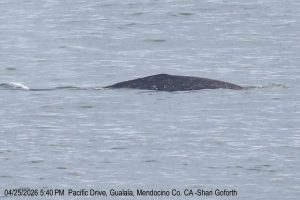
💠 seen by Shari Goforth: 1 sub-adult forager seen at the beach/sandbar at Gualala Point Regional Park first heading north, then turned around, then headed north again past the mouth of the Gualala River
also seen by Shari was a single gray heading north at Pacific Drive in Gualala🟪 TOTAL GRAY WHALES SEEN TO DATE:
🔵 342 northbound – including 6 mother/calf pairs
🔴 382 southbound
🟢 12 foragers
-
FRIDAY, APRIL 24, 2026
At Gerstle Cove today, the ocean was mostly calm with a few whitecaps and overall visibility was excellent. At about 12 noon, clouds rolled in and there was less distinction between the ocean and the sky.
💠 NO GRAY WHALES SEEN TODAY
💠 6 humpback whales – four singles and one pair
💠 8 sea lions swimming north
💠 14 harbor seals – including three moms with pups
💠 1 osprey
💠 approximately 225 brown pelicans flying north- some diving into the ocean to feed, some drifting in the ocean
🌈 TOTAL GRAY WHALES SEEN TO DATE 🟰
 339 northbound- includes 5 mother/calf pairs
 382 southbound
 11 foragers
 -
THURSDAY, APRIL 23, 2026
Today’s windy conditions made spotting blows and tracking whales a bit challenging. The ocean was covered with whitecaps but we did have a clear view all the way to the horizon.
🔆 AT THE POINT ARENA LIGHTHOUSE PENINSULA:
🔺 15 humpbacks – many breaches; some in groups of two
🔺 1 gray whale mother and calf – this pair stayed directly in front of us swimming together slowly for 25 minutes before continuing on their northbound journey; during this time; we observed the calf poop four times!
🔺 1 gray whale forging
🔺 1 sea lion swimming north
🔺 92 harbor seals – 6 mothers with pups
🔺 68 brown pelicans flying north
🔺 2 black oystercatchers
✳️✳️ early in the day we received a report from Mel Smith that he could see humpback whales near the Point Arena Pier bell buoy and many more could be seen way out to the horizon; Mel estimated about 30 humpbacks were in the area
🔆 AT SAUNDERS REEF:
🔺 3 humpbacks
🔺 47 brown pelicans flying north
🔆 TOTAL GRAY WHALES SEEN TO DATE
🔵 339 northbound- includes 5 mother/calf pairs
🔴 382 southbound
🟢 11 foragers
-
WEDNESDAY, APRIL 22, 2026 – EARTH DAY

We had excellent visibility today but the wind was blowing at 13 mph from the northwest with gusts of 18 mph. Whale blows did not stay suspended very long but rather were blown down quickly.
We received multiple reports from community members that humpbacks were being seen today from Fort Ross to Point Arena.✳️ AT THE POINT ARENA LIGHTHOUSE PENINSULA:
💠 92 harbor seals – 9 pups
💠 1 gray whale foraging close to shore; may be the same forager we observed yesterday or it may be a new recruit
💠 20 humpback whales – mostly singles; some groups of two’s and three’s; many breaches and tail lobbing
💠 1 great egret
💠 approximately 130 brown pelicans flying north, then circling around the lighthouse; many stopped to rest on the rocks on the north side of the lighthouse
💠 4 black oystercatchers
💠 1 bobcat
✳️ AT SAUNDERS REEF:
💠 12 humpbacks – many breaching and tail lobbing
✳️ TOTAL GRAY WHALES SEEN TO DATE 🔽
🔵 337 northbound – includes 4 mother/calf pairs
🔴 382 southbound
🟢 10 foragers